
Don’t Let Air Eat Your Profits: A Masterclass in Volumetric Weight and Smart Packaging
 2026-03-17 09:35:382 min read
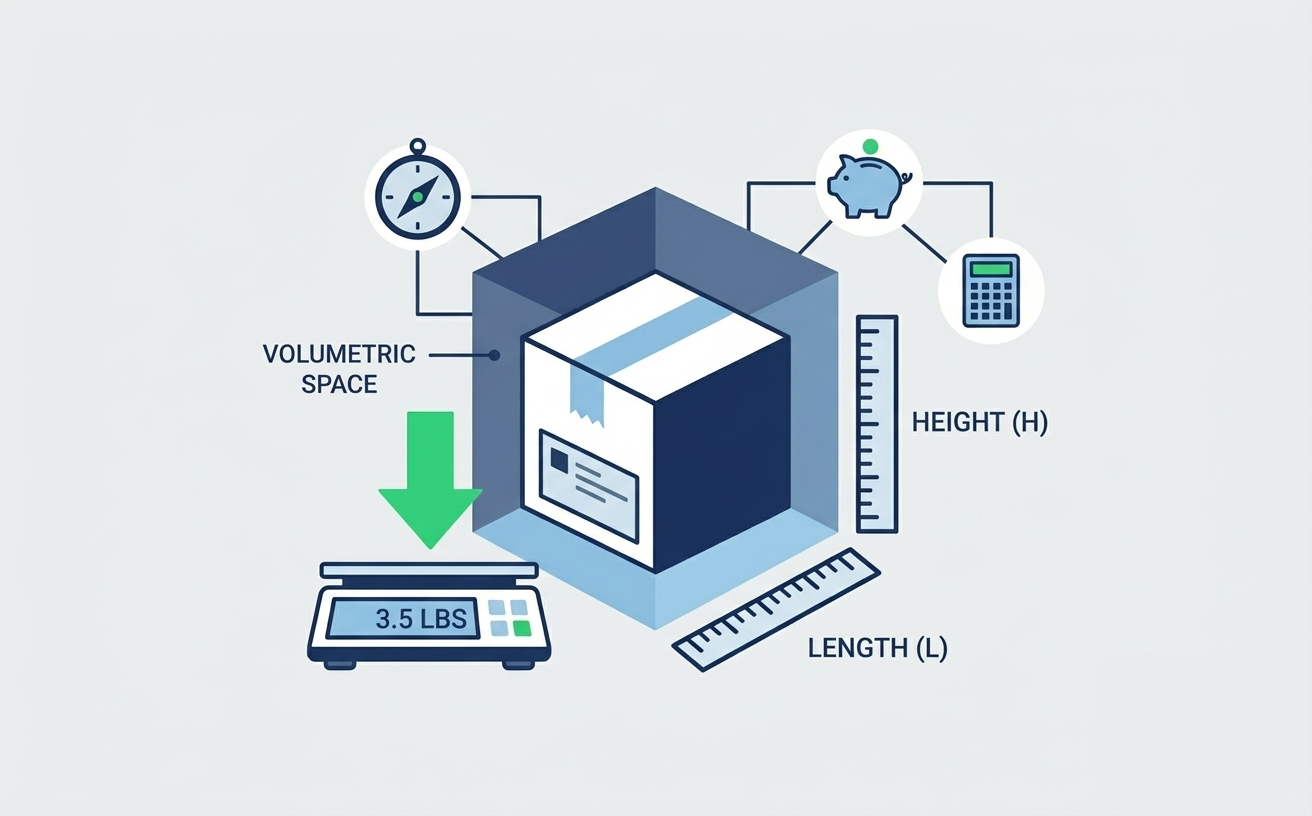
In the world of shipping, weight isn’t always measured in pounds or kilograms. Sometimes, it’s measured in inches and centimeters. If you’ve ever shipped a large box of pillows and been shocked by a price higher than a small box of lead, you’ve met the "Volumetric Weight" (also known as DIM Weight).
At Featship, we want to make sure you never pay more than necessary. Understanding how carriers calculate the cost of "space" is the key to protecting your margins.
1. What is Volumetric Weight?
Carriers like USPS, Canada Post, and Australia Post have limited space in their trucks and planes. A huge box filled with bubble wrap takes up the space of ten small, heavy boxes. To stay profitable, carriers charge based on whichever is greater: the Actual Weight or the Volumetric Weight.
The Basic Formula:
$$\text{Volumetric Weight} = \frac{\text{Length} \times \text{Width} \times \text{Height}}{\text{DIM Divisor}}$$
2. Regional Variations: The "Divisors" of 2026
Different countries use different math to determine how much your "air" costs:
- USA (USPS): Typically uses a divisor of 166 (for domestic commercial rates).
- Canada (Canada Post): Uses a factor where $1\text{ m}^3 = 200\text{ kg}$ (or $L \times W \times H \text{ in cm} / 5000$ for some services).
- Australia (AusPost): Uses a cubic weight factor of 250 ($L \times W \times H \text{ in meters} \times 250$).
Featship Tip: Our system does this math for you instantly. When you enter your dimensions, we compare it against the actual weight and show you the true "Chargeable Weight."
3. Three Pro Packaging Hacks to Save Money
Hack #1: The "Poly Mailer" Advantage
If your item isn't fragile (like clothing or soft goods), stop using boxes. Boxes have fixed dimensions that often trigger higher volumetric rates. Poly mailers are flexible and collapse around the item, effectively reducing the "H" (Height) in the formula to near zero.
Hack #2: Right-Size Your Boxes
Using a "one size fits all" box is a profit killer. If you have 4 inches of empty space filled with peanuts or air pillows, you are paying the carrier to ship that air. Invest in 3-4 standard box sizes that closely fit your most popular products.
Hack #3: Trim the Corners
If you find yourself with a box that is too tall, don't just fill it with paper. Use a box cutter to score the corners down to the level of the product, fold the flaps over, and tape it shut. Reducing the height of a box by just 2 inches can sometimes save you $5–$15 per label on long-distance shipments.
Precision is Profit
Volumetric weight is the "invisible" cost of shipping. By choosing the right packaging and being precise with your measurements on Featship, you ensure that you are paying for your product’s journey—not for the air around it.
Check your box sizes today. Small changes lead to big savings.